NASC launches new TG4 update to support anchor tie safety
The latest version of TG4 Anchorage Systems for Scaffolding was issued in 2025, and NASC has now built on this with a TG4 User Guide and TG4 Poster, launched this month to create a complete suite of guidance for the industry.
Understanding the importance of ties is fundamental to scaffolding safety, as James Attridge, Chair of the NASC Technical Committee, explains: "Ties play a critical role in ensuring the stability of scaffolding structures. Façade access and other scaffolding configurations are typically tall and narrow and therefore rely on secure attachment to a 'permanent' building or structure to maintain stability. To achieve this, anchors are often installed into existing masonry or concrete structures to provide an effective means of tying."
The new TG4 suite has been designed for everyone across an organisation, from directors, managers and supervisors at scaffolding contractors through to scaffolders on site and the client's project team.
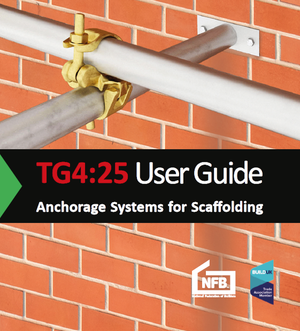
The main guidance note, TG4:25 Anchorage Systems for Scaffolding, provides detailed technical guidance on tie loads, anchor selection, proof testing and related considerations. Sitting alongside it, the TG4 User Guide is an A6 pocket booklet aimed specifically at scaffolders, highlighting the key information needed for the effective fixing of anchors, along with the factors and precautions required to ensure their integrity. It has been developed as a practical, easy to use pocket reference for anyone responsible for installing and testing drilled and cast in anchors.
Finally, the TG4 A2 Poster has been created to raise awareness at site level of just how important anchor ties really are, with the poster prominently stating that anchor ties play a critical role in ensuring the stability of scaffolding structures and preventing structural failure or collapse. A QR code on the poster links directly to further information on the NASC website.
NASC hopes this new suite of TG4 guidance will raise the profile of anchor tie safety across the whole industry and help drive further improvements in standards on site.